

Why pay increases without skill elevation quietly create ceilings, widen gaps, and accelerate
automation
Everyone can feel it, even if they cannot quite name it.
Workers feel squeezed by rising rent, food, and everyday bills.
Small businesses feel squeezed by operating costs that keep climbing.
Consumers feel squeezed every time prices inch higher.
Everyone is reacting just to stay afloat.
When everyone is reacting, no one is advancing.
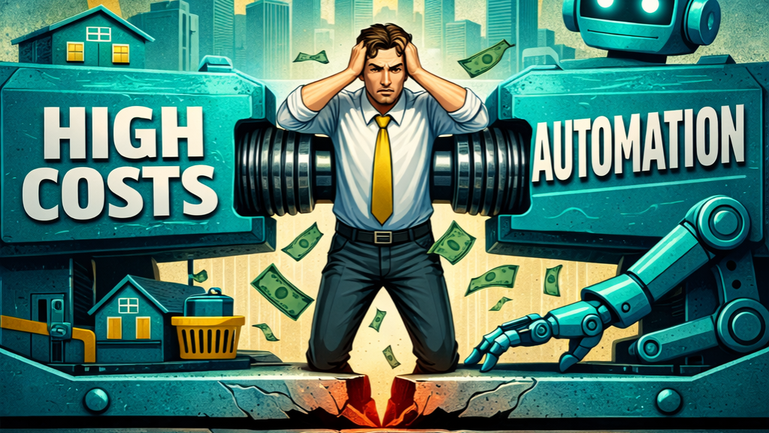
This is what I call The Big Squeeze, and it explains why so many well-intended solutions keep
producing the same frustrating outcomes.
This isn’t about villains.
It’s about pressure.
When costs rise everywhere at once,
businesses, workers, and systems all respond the same way. Not because they want to, but
because they have to.
When raises help, but do not hold
Pay increases matter.
For many people, they are necessary just to keep pace with a cost of living that has risen far
faster than wages over the last decade. In the short term, raises help people breathe. They
offer relief. They create space.
But raises alone do not relieve the pressure underneath.
When wages rise in service-heavy and labor-dependent industries, most small businesses
cannot absorb that cost indefinitely. Margins are already thin. There is little room to maneuver.
So prices rise to offset the increase.
Not out of greed, but out of survival.
At first, consumers tolerate it.
Then they pull back.
Spending slows.
Margins tighten further.
That is when the squeeze intensifies.
The breaking point for small businesses
When costs keep stacking, small businesses face a narrowing set of options.
Raise prices again and risk losing customers.
Cut hours or staff.
Or find ways to reduce labor costs altogether.
This is where automation and AI enter the picture.
Not as villains.
Not as replacements by choice.
But as pressure responses.
If a task can be done more efficiently with fewer ongoing costs, fewer scheduling issues, and
fewer compounding expenses, businesses will move in that direction. Especially when the
alternative is closing their doors.
Automation, in this context, is not ideological.
It is economic.
It is chosen last, not first.
The timing trap no one talks about
The most damaging part of this cycle is timing.
Prices rise first.
Costs of living adjust upward.
Only later do jobs begin to disappear.
That means displacement happens after people are already paying more for housing, food,
transportation, and basic services.
When jobs are reduced or automated at that stage, workers are not just unemployed.
They are unemployed in a more expensive world.
That is how ceilings form.
People work harder just to maintain position.
Upward mobility slows.
Options narrow.
Without access to new skills or higher-leverage roles, progress stalls.
Why the gap widens
Over time, this sequence quietly widens separation.
Those who own capital, systems, or scalable tools adapt faster.
Those dependent on hourly labor face shrinking paths forward.
The result is not overnight collapse.
It is gradual compression.
Fewer local businesses.
Fewer traditional jobs.
More dependency.
Less access.
People often blame automation and AI for this outcome.
But those technologies are responding to pressure, not creating it.
The real divide is not technology versus people.
It is adaptability versus stagnation.
Access versus exclusion.
Leverage versus labor alone.
What actually changes the outcome
This is not an argument against fair pay.
And it is not a defense of unchecked automation.
It is a reminder that wages alone cannot solve a structural problem.
Real relief comes from pairing pay increases with:
- Skill elevation that keeps people valuable as work changes
- Productivity gains that justify higher wages without fueling inflation
- Access to tools and systems that increase leverage rather than replace people
- Preparation before displacement, not reaction after
Higher wages buy time.
Skills and access determine what happens next.
Naming the moment
The Big Squeeze is not caused by one policy, one industry, or one technology.
It is what happens when costs rise everywhere at once, and everyone is forced to react
instead of advance.
Until we talk about skill elevation, access, and productivity alongside pay, the cycle will
continue.
Relief will come and go.
Pressure will keep building.
And ceilings will quietly lock into place.
Naming the squeeze is the first step to easing it.